
Contracts
Contracts play a central role in translating regulatory and voluntary frameworks into concrete commitments that guide implementation in practice.
The figure below presents a summary of how international law, international guidelines and principles, regional and national legislation, and self-regulation influence companies’ contracts.
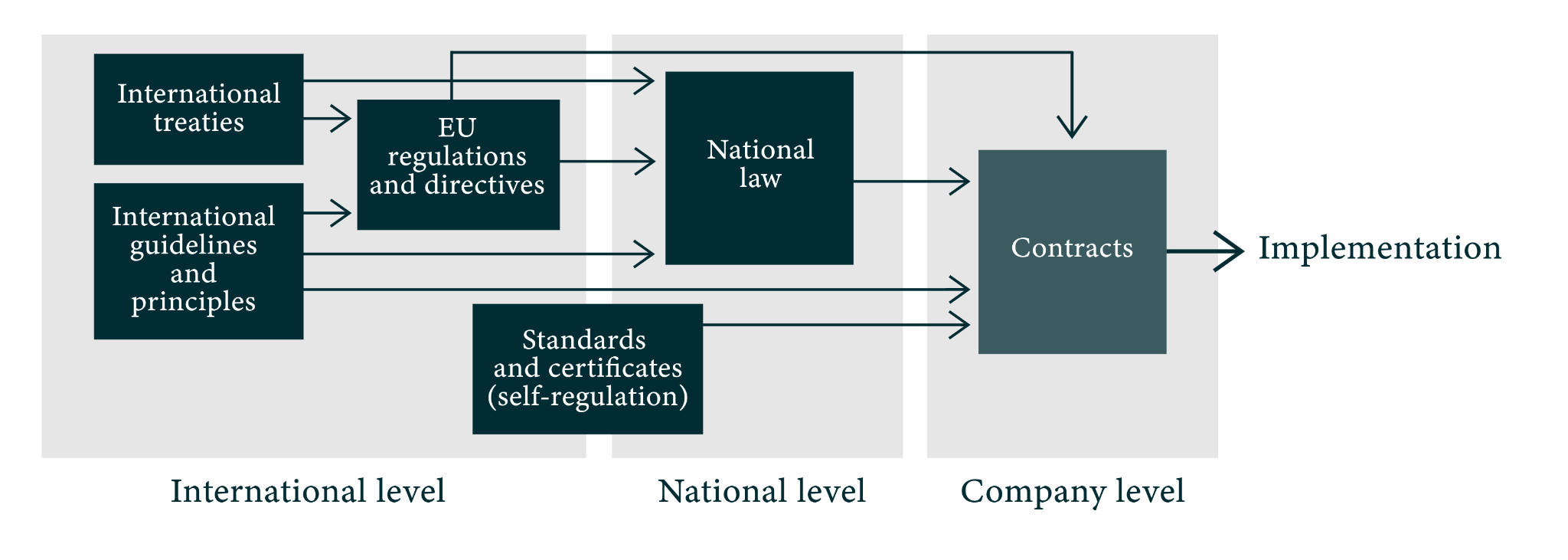
The sources of corporate sustainability regulation and their influence on companies’ contracts. More…
International treaties bind states, which signed and ratified them. They become binding legislation towards companies, when nation states and/or the EU implement them. EU regulations bind states directly and directives after the member states have implemented them in their own legislation.
International guidelines and principles, such as the UNGPs or OECD’s numerous guidelines do not directly bind companies, unless companies voluntarily choose to adopt them. However, these voluntary frameworks have served as an example for both EU regulation and national legislation.
Besides international guidelines and principles, there are a lot of private self-regulation guiding companies in their strivings for sustainability. There also exist voluntary standards and certificates of national origin. In the figure they are shown in the box in between the international and national levels.
The figure illustrates the important role of companies in implementing sustainability regulations. The huge amount of regulation at international and national levels can easily appear to be a complex web of regulations of different types and levels that affect one another. However, with the right expertise, companies can gain a competitive advantage by using contracts to align, operationalise and implement these requirements across their supply chains. If implementation fails, companies risk being labelled careless greenwashers.
Exercise: Mapping the sources of sustainability requirements in your company
Complete this exercise in a team consisting of people from the sustainability, legal/compliance, procurement, product, technical, and quality teams, for example. You can also complete this exercise by yourself.
Identify the most relevant corporate sustainability regulations that apply to your company
International guidelines and principles:
Begin mapping with international guidelines and principles: Global Compact, UNGPs, SDGs, OECD Guidelines.
- Is your company committed to any of these?
- How do you know?
- Do you ask your suppliers to commit to the same international guidelines and principles?
- Why or why not?
EU sustainability rules:
After mapping the international guidelines and principles, address the EU sustainability rules that apply to your products, operations, and value chain.
- Which regulations are the most relevant, and why?
Note that even if your company is not directly within the scope of a regulation, the requirements can still apply to your company, for instance, via contracts.
Self-regulation:
What about international and national standards and certificates?
- Is your company committed to any of them?
- Does your company require its suppliers to adhere to the same standards and certificates?
- Why or why not?
National law:
Now, choose one of your company’s main operating countries and list the key national laws relating to the protection of human rights, the environment and preventing corruption.
As you map the sources of sustainability requirements in your company, you may notice that they come from different sources and apply in different ways across your operations and supply chains. In the next modules, you will learn how to make sustainability requirements part of the contract stack, clearer, more structured, and more workable in practice.