
Sustainability due diligence
Juho Saloranta: Human Rights and Environmental Due Diligence
* embedded from the Panopto platform at Aalto University (privacy policy)Sustainability due diligence is the process companies should carry out to identify, prevent, mitigate and account for how they address the actual and potential adverse impacts in their own operations, their supply chain and other business relationships. According to the OECD Guidelines, the process consist of the following phases:
- embedding responsible business conduct into policies and management systems
- identifying and assessing adverse impacts
- taking action to prevent or reduce harm
- tracking effectiveness and improve
- responding when issues occur, including enabling remedy where relevant
- documenting and communicating what is done and why
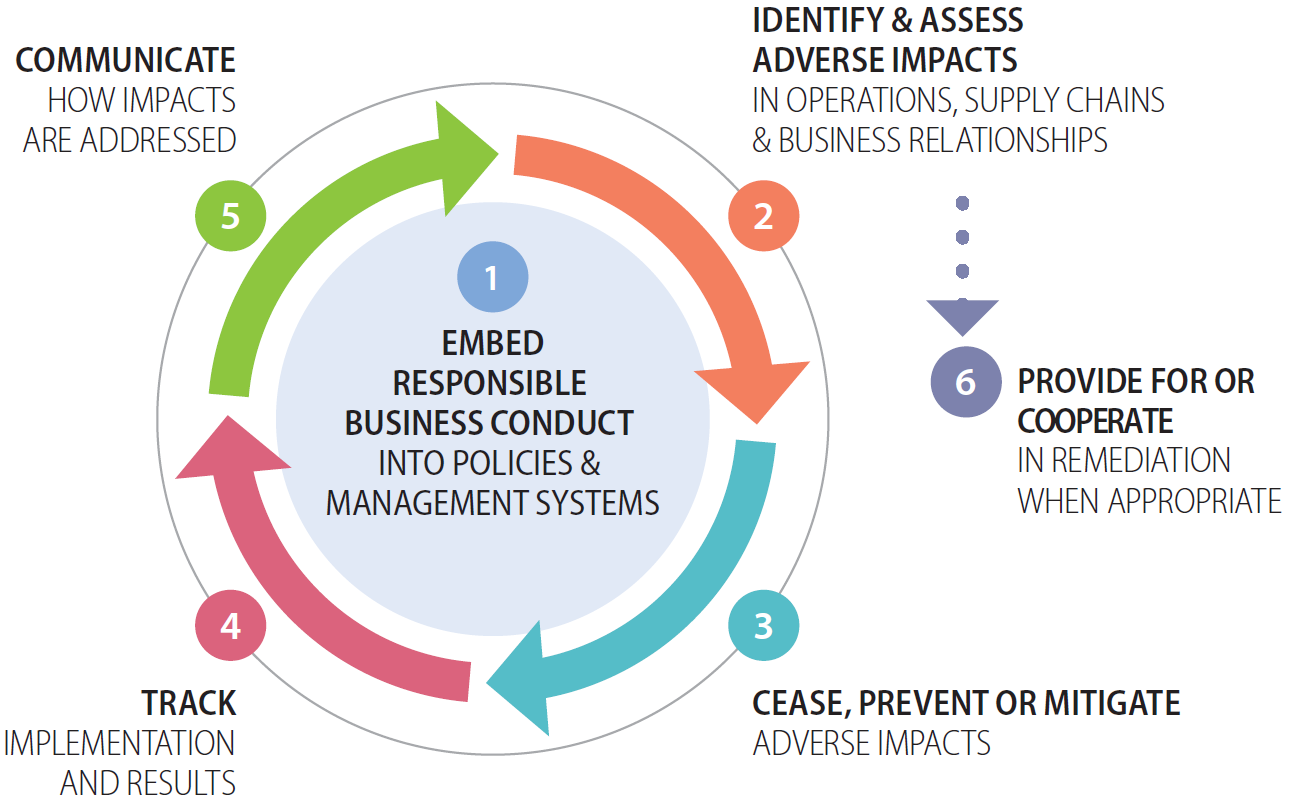
Sustainability due diligence is a continuous process for managing a company’s impacts across its operations, supply chains and business relationships. More…
Each numbered step in the diagram represents a key phase in the due diligence process.
- At the centre, companies **embed responsible business conduct into policies and management systems**.
- They then **identify and assess adverse impacts** in their operations, supply chains and business relationships.
- Based on this, they **take action to cease, prevent or mitigate** adverse impacts.
- They **track implementation and results** to understand whether these actions are effective.
- They **communicate how impacts are addressed**, making their actions transparent.
- Where needed, they **provide for or cooperate in remediation**.
- The circular arrows show that due diligence is an **ongoing, iterative process**, where each step informs the next.
Due diligence should be done together with relevant stakeholders, such as employees, suppliers, and non-governmental organizations (NGOs). Sustainability due diligence is a process understood as an obligation of means: you are expected to act reasonably and systematically, not to promise perfection.
Sustainability due diligence in practice next page