
Communication complexity and implementation friction
Contract language often reflects inherited drafting habits and contractual legacy rather than the needs of its users. Formality, tradition, and the reuse of templates can lead to communication that is more complex than necessary.
Example 1: Compressed contractual structures
Complex contractual sentences often combine multiple actions, conditions, exceptions, and implementation expectations into a single structure. In sustainability-related contexts, a single sentence may simultaneously combine multiple product requirements, compliance conditions, technical specifications, and exceptions.
One way to identify this complexity is to examine how many separate requirements, conditions, specifications, or operational expectations are embedded within the same contractual structure. This helps identify potential sources of structural and cognitive complexity.
The following example, an excerpt from the General Terms and Conditions of a Finnish company, illustrates this:
The Products shall conform to the Agreement, and … be compliant with all safety Laws in all respects, including be made of (and packed in) non-hazardous and safe materials and components, or where the Customer purchases Products such as chemicals, safety shall be ensured by all appropriate means required by the Laws and the relevant authorities, and by secure packaging, handling and storage; ….
Even though the sentence is long, its length is not the main challenge, but the number of different requirements, expectations, conditions, and elements embedded within the same structure. If we decompose the sentence into its operational components, the complexity of the structure becomes more visible:
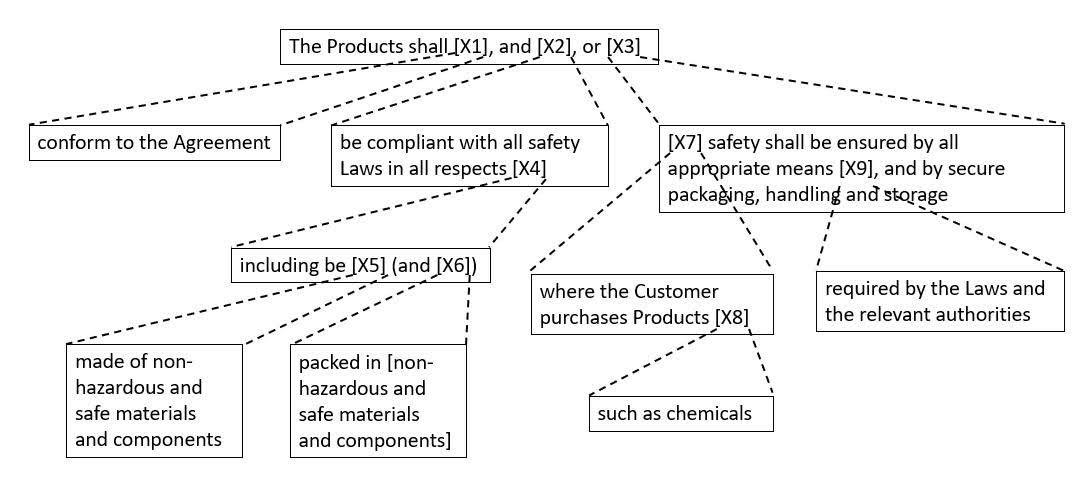
The figure illustrates how contract drafting may compress multiple requirements into a single sentence, hierarchically embedded in one another. Although this style may appear legally comprehensive, even precise, it can create significant cognitive load and make it difficult for users to identify what is required and when.
This type of structural complexity may prevent sustainability-related contract text from effectively supporting implementation in day-to-day work. Identifying and clarifying such structures can help make contractual requirements more understandable, visible, and actionable. The example illustrates how operationally significant sustainability-related content may remain embedded in Standard Terms and Conditions, within broader procurement, safety, compliance, or operational governance clauses rather than appearing as standalone sustainability clauses.
Example 2: Definitions and references
Implementation expectations and operationally significant content may remain fragmented across definitions and references within and beyond the contract stack.
The use of separately defined capitalised terms – as in the sample sentence in Example 1 – requires readers to connect the clause with definitions elsewhere in the contract documents.
Contracts may also refer to external regulatory or governance frameworks, such as OECD Guidelines or UN Guiding Principles, without clearly explaining how these frameworks relate to the contractual relationship or what implementation expectations follow from them in practice.
As a result, users may need to navigate across multiple contractual and external documents – sometimes hundreds of pages – in order to understand:
- what is expected,
- which requirements apply,
- who is responsible,
- and how implementation should occur in practice.
While such definitions and references may help avoid repetition and support modularity, consistency, and alignment with broader governance frameworks, they may also increase interpretive effort and make implementation expectations more difficult to identify, navigate, and operationalise.
Other recurring language and communication issues include:
Example 3. Sustainabilitese, duediligencese, and other jargon
Traditional contract language is often associated with legalese: dense and formal legal language that may be difficult for non-lawyers to understand and use. Contract drafting often maintains a high degree of formality, either intentionally or through inherited drafting habits and template reuse.
In sustainability-related contracting, additional forms of jargon are increasingly emerging. We use the term sustainabilitese to refer to complex, abstract, or jargon-heavy sustainability language that is difficult to understand, interpret, or apply in practice. Sustainabilitese may create an appearance of meeting sustainability expectations without enabling concrete implementation or action.
Sustainability-related contracts increasingly incorporate terminology and formulations originating from regulation, governance frameworks, and international guidelines and principles. We refer to this emerging form of dense governance, compliance, and due diligence language as duediligencese.
Duediligencese may appear through specialised terminology such as contractual assurances, sustainability due diligence, adverse impacts, remediation, or grievance mechanisms. Such concepts are not necessarily self-explanatory to all users involved in implementation or operational decision-making. Duediligencese may also appear through indirect governance-oriented formulations where operational expectations are communicated through abstract institutional language rather than through concrete action-oriented instructions.
Duediligencese may further increase interpretive effort when contracts incorporate extensive references to external regulatory, governance, or soft law frameworks without clearly explaining their operational implications within the contractual relationship.
Example 4. Unclear abbreviations or categories
The use of abbreviations is another common feature in contract language, and one that causes understandability issues. Even though many of the most commonly used abbreviations are often repeated throughout the contract stack, they may not be familiar to someone who encounters them for the first time. What’s more, without clarification, they may even be mistaken for another concept with a similar name and/or abbreviation.
One way to reduce interpretive effort is to write out the abbreviation when it is mentioned for the first time. A brief explanation or definition of the concept may further support understanding. For well-known, commonly used abbreviations this might not be necessary (for instance, EU for the European Union), but anything not used in general language use could use a definition. This applies especially to sustainability matters, as sustainability concepts are often referred to by their abbreviations (e.g., HREDD, CS3D/CSDDD, HRIA), which may not be immediately obvious to all users of the contract without a further clarification.
These features increase the cognitive effort required to interpret the contract. Users must first decode the language before they can understand what is required of them in practice.

The less effort users need to spend on interpreting contract language, the more they can focus on implementing it.
The issue is rarely the complexity of the underlying requirement itself, but the way it is expressed.
Structure and design: When information is hard to navigate next page