
Contract design patterns
Contract design patterns are reusable solutions to recurring problems in contract design and communication. Their use offers a structured and systematic approach to improving contract usability and clarity.
Examples of contract design patterns include timelines and swimlanes.
Timelines
Many contract clauses describe obligations that unfold over time but present them as a single block of text. The timeline pattern helps restructure such clauses by aligning contractual requirements with key phases of the supply and delivery process. By making clear what is expected before, during, and after delivery, the pattern helps users quickly understand phase-specific responsibilities and supports the effective implementation of sustainability requirements across the supply chain.
Example
The following land use clause bundles several distinct obligations into a single provision, covering preparations before construction, restrictions during works, and restoration duties after completion.
Land use
The Supplier shall, prior to commencing works, enter into the necessary agreements with affected landowners and other relevant rights holders concerning access routes, traffic arrangements, and temporary storage areas. The Supplier shall not extract, remove, or use soil, gravel, or other aggregate materials from within or adjacent to the infrastructure corridor or from any gravel pit without the prior consent of the relevant landowner. Upon completion of demolition or removal works, the Supplier shall ensure that agricultural land is restored such that the upper soil layer, to a depth of at least 0,5 meters, remains suitable for cultivation. Former structure sites shall be cleared, ensuring that no surplus soil, stones, or debris remain on the site.
In the following timeline graph, the same obligations are visually reorganised according to the three main phases of the works.
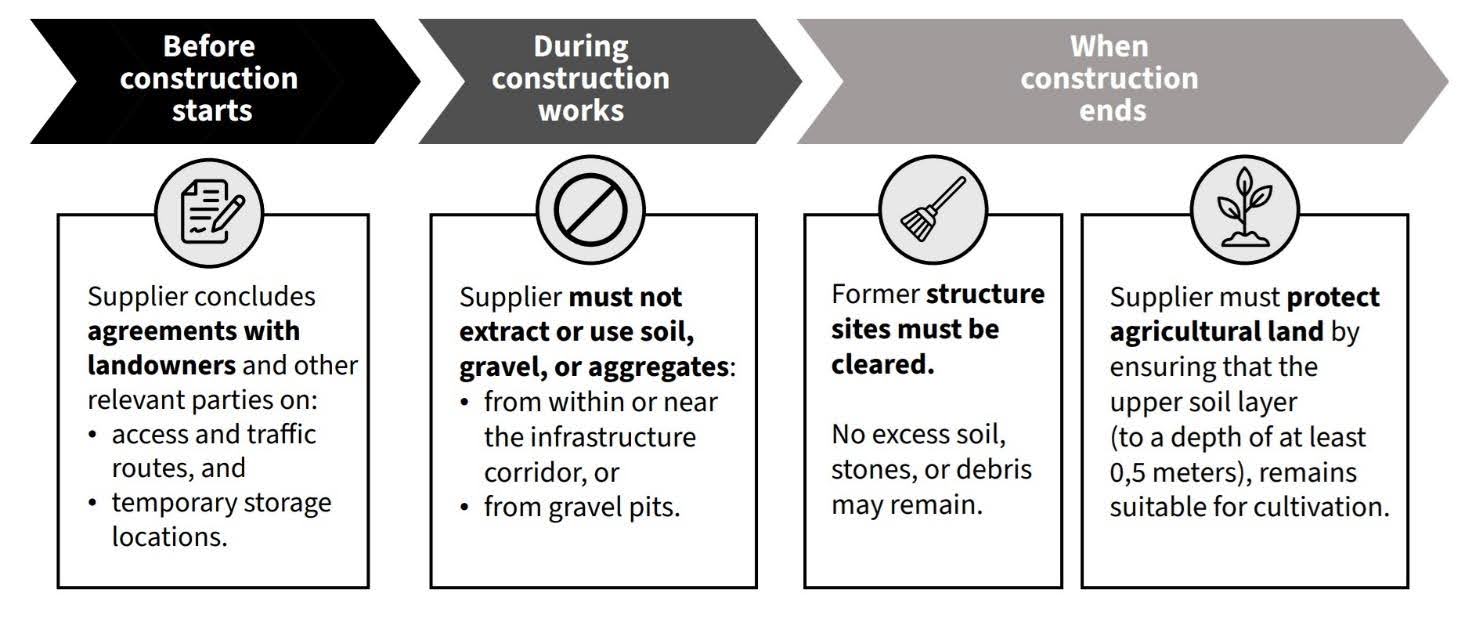
Timeline showing obligations at different stages of a construction project. More…
The image presents a horizontal timeline with three phases: before construction starts, during construction works, and when construction ends. Each phase contains boxed instructions describing supplier responsibilities.
Before construction starts, the supplier agrees with landowners and other relevant parties on access routes, traffic routes, and temporary storage locations. During construction works, the supplier must not extract or use soil, gravel, or aggregates from the infrastructure corridor or nearby gravel pits.
When construction ends, former structure sites must be cleared so that no excess soil, stones, or debris remain. The supplier must also protect agricultural land by ensuring that the upper soil layer remains suitable for cultivation.
The visual uses a timeline format to show when different obligations apply during the project.
Swimlanes
Swimlane patterns are visual tools used to show how rights, duties, and procedures are divided between the parties to a contract. Instead of scattering responsibilities across multiple clauses, a swimlane diagram places each party in its own “lane” and maps actions and decisions across those lanes. This makes it easier to see how processes unfold, who is responsible for what and when interaction between the parties is required.
Example
The following clause describes a grievance handling procedure related to workers’ rights. While the original contract wording appears straightforward, it embeds a multi-step process involving a series of actions: assessments, notifications, information requests and negotiations.
Grievance mechanism
The Supplier shall establish a grievance mechanism enabling workers employed by the Supplier or its subcontractors to submit complaints regarding working conditions, labour rights, or other human rights concerns related to the performance of this Agreement.
The Supplier shall acknowledge receipt of each grievance, assess its severity, and determine appropriate corrective actions. Where the grievance indicates a serious or systemic issue, the Supplier shall inform the Buyer without undue delay. The Buyer may request information regarding the grievance and the proposed corrective actions and may require additional measures where the response is deemed insufficient. The Supplier shall implement agreed corrective actions and report on their completion.
The following swimlane diagram makes this process explicit by showing how the procedure unfolds over time. In particular, it reveals how the Supplier acts as the primary operator of the mechanism, and how the Buyer’s role is exercised through evaluation and approval rather than direct action.
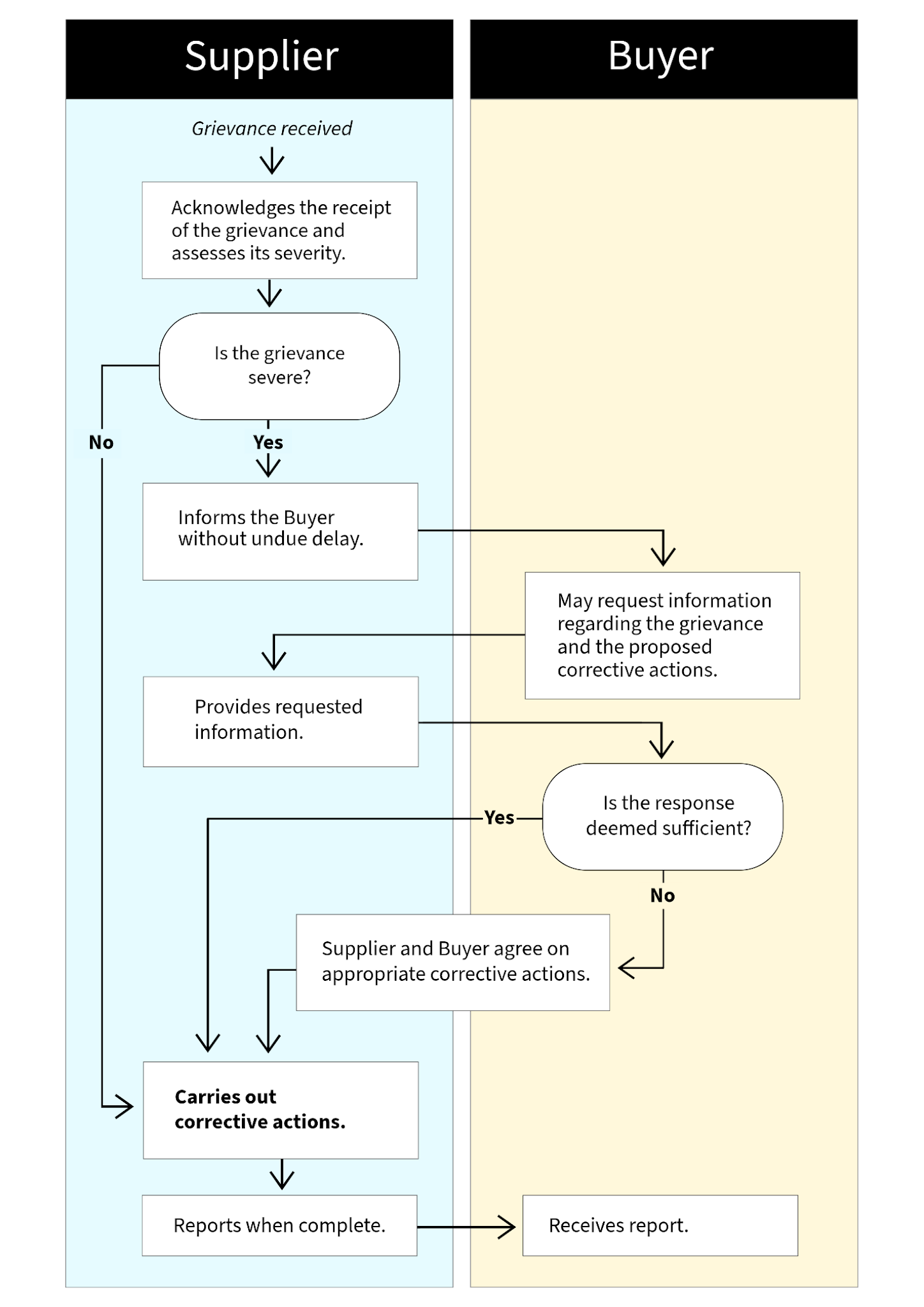
Swimlane showing how a supplier and buyer handle grievances and corrective actions together. More…
The image is a two-column swimlane diagram with separate lanes for the Supplier and the Buyer. It shows the process for handling a grievance and carrying out corrective actions.
The process begins in the Supplier lane when a grievance is received. The supplier acknowledges the grievance and assesses its severity. A decision point asks whether the grievance is severe.
If the grievance is not severe, the process moves directly to corrective actions. If it is severe, the supplier informs the buyer without undue delay. The buyer may then request additional information about the grievance and proposed corrective actions. The supplier provides the requested information.
A second decision point in the Buyer lane asks whether the response is sufficient. If not, the supplier and buyer agree on appropriate corrective actions together. If the response is sufficient, or once agreement is reached, the supplier carries out the corrective actions.
Finally, the supplier reports when the actions are complete, and the buyer receives the report.
The visual uses swimlanes and arrows to show responsibilities, decision points, and collaboration between the supplier and buyer throughout the process.
Clear language, visible implementation logic, and well-designed communication can make sustainability-related requirements easier to understand, navigate, coordinate, and implement. However, implementation also depends on whether those requirements are realistic and aligned with operational and commercial realities. The next section focuses on how contracts can support feasible and workable sustainability practices.
Solution 4: From unfeasible or unrealistic to feasible and realistic requirements next page