 JARGONFREE Compass for Sustainable Contracting
Bridging the implementation gap: turning sustainability goals into contracts that work
The JARGONFREE Compass for Sustainable Contracting helps companies bridge the implementation gap between sustainability goals, related contract content – ‘words on paper’ – and real-world practice across supply chains.
The Compass supports organisations in assessing whether sustainability-related content is clear, realistic, actionable, and capable of guiding implementation in day-to-day work.
Designed as a cross-functional tool for commercial, procurement, contract, legal, sustainability, and operational teams, the Compass helps organisations strengthen implementation, align understanding across functions, and move towards more proactive and impactful sustainable contracting.
We recommend one of two starting points to your journey:
Take our brief self-assessment test to identify the focus areas for your organisation’s implementation pathway. Locate your organisation on the scorecard scorecard
or
Start reading from the first page, establishing context between corporate sustainability and contracts. I. Contextualizing corporate sustainability next page
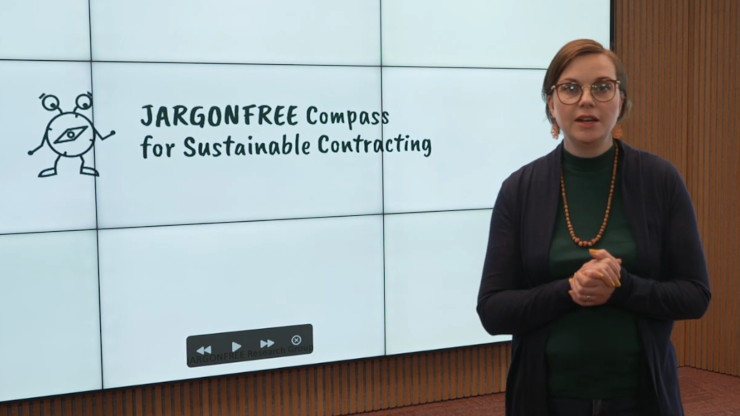
The 5 minute welcome video introduces the JARGONFREE Compass for Sustainable Contracting. Read the transcript…
Welcome to the JARGONFREE Compass for Sustainable Contracting, a practical compass for navigating sustainable contracting.
Many companies already include sustainability-related content in their contracts, policies, Codes of Conduct, and supplier requirements. However, these commitments and requirements are often difficult to implement, monitor, or translate into everyday work, particularly across supply chains and organisational practices.
This is the implementation gap: the disconnect between what contracts say – ‘words on paper’ – and what actually happens.
The JARGONFREE Compass focuses on helping companies bridge this gap. It helps companies turn sustainability goals into clear, actionable, and implementable commitments and requirements across contracts and supply chains. A special focus of the Compass is in contract language.
Companies operate at different starting points. In some, contracts are not used for sustainability, and related requirements remain absent or inactive. In others, they are addressed only reactively when issues arise. More advanced companies embed them proactively in processes and use them to drive continuous improvement and collaboration. The Compass is designed to support this transition – from sustainability-related content as “words on paper” towards implementation and embedded organisational practice.
The Compass focuses not only on how sustainability is regulated and where sustainability-related content is located in supply chain contracts, but also on whether this content is understandable, actionable, realistic, feasible, and capable of guiding implementation in practice.
The Compass is designed for sustainability, supply chain, procurement, sales, contract, compliance, business, risk management, and legal teams involved in shaping and implementing supply chain contracts across organisations.
You can use the Compass as a personal guide to read, assess, and rethink contracts in your own work. At the same time, the challenges the Compass identifies rarely sit within one function alone. The full value of the Compass emerges when used across teams to support shared understanding, coordinated action, and more implementation-oriented contracting practices.
The Compass is structured around four Modules: The first Module contextualizes corporate sustainability and related regulation. The second module focuses on contracts’ role in driving value chain sustainability. The third Module is a diagnostic tool for recognizing and analyzing common problem patterns in contracts and contracting. The fourth module introduces solutions to the problems introduced in Module III. Also, the Compass introduces a Scorecard that helps companies reflect on different contracting approaches – from inactive and reactive practices towards more proactive and transformative approaches to sustainable contracting. You can proceed from one Module to another or pick and choose content that is of particular interest to you.
The Compass is not
- An automated tool for assessing, reviewing, or improving contracts
- A clause library (although selected links and examples are provided in the Compass)
- A legal drafting manual or a contract style guide
- A new set of sustainability requirements
- A compliance checklist
- A one-size-fits-all solution
The Compass is
- A practical orientation tool for sustainable contracting
- A way to understand how sustainability-related content functions across contracts and supply chains
- A framework for diagnosing common problem patterns and addressing their causes
- Support for aligning sustainability-related content across the contract stack
- Support for making sustainability-related contract content clearer, more realistic, more actionable, and easier to implement
- A shared tool for sustainability, supply chain, procurement, sales, contract, compliance, business, risk management, and legal teams working together
- Support for moving from inactive and reactive approaches towards more proactive and transformative practices in sustainable contracting
Using the Compass
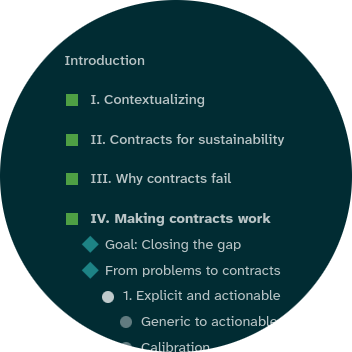
The Compass is structured around four modules, which build on one another:
- Contextualizing corporate sustainability
- Contracts as drivers of sustainability
- Why contracts fail
- Making contracts work
However, all content is carefully crosslinked, so that you may also choose your own journey.
Our virtual hosts lead you through the Compass:
Kompis points out the most important facts and actions on how to indentify and overcome the implementation gap.

Kynis, our language expert, highlights where language plays a particularly important role in improving contracts.
Explore our content types
The Compass explains core concepts and strategies in its main text, along with supporting formats:
Video explainers provide concise introductions to core topics of sustainable contracting, by the researchers from the JARGONFREE research group.
A comprehensive glossary defines core terminology and concepts, with links to relevant parts/points in the Modules. Glossary terms are highlighted in the module texts for single-click access.
Exercises, both interactive (like small quizzes) and as worksheets, are designed as part of your journey or for taking them to a team.
Handy checklists and key takeaway sheets can be accessed and downloaded as handouts for further reference.
A variety of external resources is recommended in the modules.
Crosslinks tie together contexts, issues and solutions accross the Compass.
Our Contract Language project (2024-2026) is funded by the Kone Foundation.
The JARGONFREE Compass for Sustainable Contracting is published in collaboration with the WorldCC Foundation.